Focused repair benches
Guitar, amplifier, and keyboard work orders open in focused repair benches while sharing one commercial workspace for parts, services, payments, messages, scheduling, photos, printing, and history.
Version 0.3.60 adds durable support ticketing and independent backup/retention groundwork that no longer requires a development PC to remain on nightly after the verified TrueNAS cutover.
Authenticated Report Issue submissions receive a durable SUP-###### ticket number. Authorized FretTrack staff can triage the ticket, retain append-only status and resolution history, and see retry-safe email-delivery evidence.
FretTrack now includes an independent Linux/TrueNAS backup framework for verified database, Storage object, and source recovery copies. It uses encrypted local and private offsite repositories, fail-closed retention, and isolated restore-drill safeguards. These are operational controls; backup contents and infrastructure details are not customer-visible.
Recovery testing identified and corrected an omitted private database schema before TrueNAS cutover. Corrected snapshots validate required schemas, routines, trigger dependencies, extensions, and exact row counts before acceptance, while older incomplete recovery evidence remains clearly labeled rather than being treated as a successful full restore.
The production backend also retains Supabase Pro managed daily database recovery points. Provider backups do not include actual Storage files, so FretTrack maintains a separate object-backup path. PITR is not enabled, and no paid add-on was changed for this release.
This work strengthens future SOC 2 readiness. FretTrack does not claim SOC 2 compliance or certification.
Customer profiles now offer sortable and paged job history, direct work-order and billing links, received-date shortcuts, and a Balance Due shortcut. Payment history is available in the same account workspace.
Institutional contract estimates now default to no expiration and state that clearly in printed and emailed copies. If an issued estimate needs correction, owners and admins can choose Create editable correction; the corrected version starts without an inherited expiration while the previously issued copy remains intact.
For one verified external payment covering several work orders, an owner/admin can keep the original transaction on one job and apply only its excess customer credit to another directly linked job for the same customer. Credit allocations and reversals are paired, retry-safe, and retained in the audit history. A FretTrack payment void never initiates a refund through Venmo, a bank, or a payment provider.
Accounting now supports quarterly, annual, UK tax-year, and exact custom closeout periods. It separates recognized sales from open work orders, retains deposits in the payment ledger, rolls receivables forward, flags invoice and ledger exceptions, compares entered external statements, and exports an accountant review package. This is sales-side evidence rather than a filed return or complete general ledger; expenses, payroll, bank activity, purchase/input VAT, depreciation, owner transactions, and provider fees remain outside FretTrack.
Authenticated Report Issue submissions now receive a durable SUP-###### support-ticket number. FretTrack retains private triage and resolution history separately from the restricted security and availability incident register.
Migration-history parsing and linked-schema release safeguards were also strengthened. These are steps toward stronger SOC 2 readiness; FretTrack does not claim SOC 2 compliance or certification.
Access and onboarding screens, along with Job Detail’s draft-field editing, now have focused code boundaries and regression tests. The existing customer-unlink confirmation, VAT and discount controls, instrument measurements, and Damage Map editing remain part of the same work-order workflow.
App deployment now stops if production database changes are pending or the linked application schema differs from committed migrations. A daily read-only repository check flags open pull requests unchanged for seven days. The schema comparison runs before deployment; it is not continuous hosted-database monitoring.
This is groundwork for stronger SOC 2 readiness, not a SOC 2 audit or certification. It does not change Shop or Pro pricing, entitlements, or customer-facing processes.
Pro owners and admins can create a secure customer link from a saved work order’s Parts & Billing section. The link is random, expires after 30 days, and is revoked immediately when staff create a replacement link.
The customer sees only that work order’s status, target date, plain-language progress message, current or final balance, staff-recorded payment total, and shop contact details. It does not expose shop-private notes, photos, Damage Maps, custody evidence, technician identity, payment method details, or any other customer/work order.
In Shop Settings → Customer Work Order Portal, a Pro shop can add optional payment instructions, a Venmo handle, and a Zelle contact. These are instructions only: FretTrack does not collect card data, initiate payment, or automatically mark a work order paid. Staff still verify and record off-platform payments in Parts & Billing.
Normal work-order saves and photo actions also now update only the affected record, reducing unnecessary whole-shop reloads.
FretTrack provides account-level multi-factor protection on every plan. Each user can enroll a TOTP authenticator app for six-digit verification, or register a compatible hardware security key/passkey for passwordless sign-in. Users can manage their enrolled factors from Shop Settings, and security events record enrollment and sign-in outcomes without storing secrets or live codes.
Mandatory privileged-account enforcement remains a separate database-backed rollout after active owners and admins have enrolled, so a normal deployment cannot unexpectedly lock a working shop out. FretTrack is working toward stronger security controls and does not claim SOC 2 certification.
The new public Engineering and Security page explains the controls behind FretTrack releases: shop-scoped database authorization, reviewed migrations, automated regression and browser checks, dependency review, verified backup manifests, restore exercises, incident procedures, and change records. AI-assisted tools may help implementation, but generated output is never treated as proof that a change is correct.
Pro shops can classify a customer as an Institution / organization and retain named music-department, billing/accounts-payable, purchasing, facilities, and other contacts without duplicating customer records. Contract estimates can cover multiple instruments before individual work orders exist, retain ROM, Budgetary, or Definitive accuracy classes, and preserve revisions and numbered change orders.
From the Estimates workspace, staff open the exact saved contract estimate, print it as a document, or select Email estimate to choose a saved institution contact and send it. Printing creates only a PDF; it does not send an email. Approved definitive work can deliberately create linked work orders per instrument.
The Customer workspace now gives the directory and selected profile their own desktop scroll areas, while Contact & account uses a clear two-column field layout.
The Work tab now includes Private Shop Notes for employee-only context. These notes stay with the shop-scoped work order and are not included in customer emails, estimates, invoices, job sheets, customer reports, or public estimate links.
Guitar neck inspections now create a visual string-action summary from entered treble and bass measurements at the 3rd and 12th frets. The visual follows the shop's inch or millimetre setting; entered values remain authoritative and the drawing is not shown to scale.
Customer profiles also restore automated service-reminder consent as a clearly visible, fully labeled checkbox.
Account security now includes optional security-key/passkey enrollment and passwordless sign-in alongside TOTP authenticator protection. Compatible browsers and hardware keys are required; each person must enroll their own factor.
Inventory now includes a Shop-and-Pro Reorder Planner. It uses on-hand quantity, reorder point, desired stock, vendor package size, optional vendor lead time, and quantities still due on Ordered or Partially Received purchase orders. Suggestions use whole purchase units and can prepare an ordinary unsaved draft PO for staff review; FretTrack never places an order automatically.
Inventory checkboxes now retain a consistent compact size, purchasing fields use clearer vendor-package wording, and measurement cards use a smaller layout. The public pricing section and Billing guide provide an explicit Shop-versus-Pro checkmark comparison showing that the current Reorder Planner is included in both plans while later predictive demand and seasonal forecasting will require Pro.
Pro Shop Settings now include Reminder Operations monitoring for sending state, opt-in coverage, scheduled work, retries, sends, and staff skips. Owners and admins can recheck eligibility, skip one reminder with a recorded reason, and restore it to the normal eligibility checks. Staff skips survive queue rebuilds, and customer opt-ins and opt-outs append a shop-scoped consent history.
Read the complete Automated Service Reminders manual for the operating steps and safety boundaries.
FretTrack now includes MusicShop360 customer CSV import with reviewed duplicate handling, reusable customer instrument profiles, expanded vendor records with safe CSV import/export, and transactional vendor returns. Customer email replies enter a shop-isolated Messages inbox and may play a notification when Sound is enabled.
Vendor returns use a simple Draft → Requested → Shipped → Credited workflow. Stock changes only at Mark Shipped and cannot be removed twice by retrying the same operation. Vendor credit records remain separate from customer invoices and payments.
Work orders now include a Shipping tab for manual customer ship-back records, saved address snapshots, printable summaries, editable retry-safe tracking emails, and operational shipping totals/CSV export. FretTrack still does not buy labels or call carrier APIs.
The application now uses a grouped workspace navigation rail, a quieter control hierarchy, an operational Current Jobs summary, and consistent responsive behavior. Shops can select Use Device Theme or choose Bench Dark, Shop Light, Amber Tube, Seafoam, Blackguard, Burgundy Burst, Blue Steel, or High Contrast.
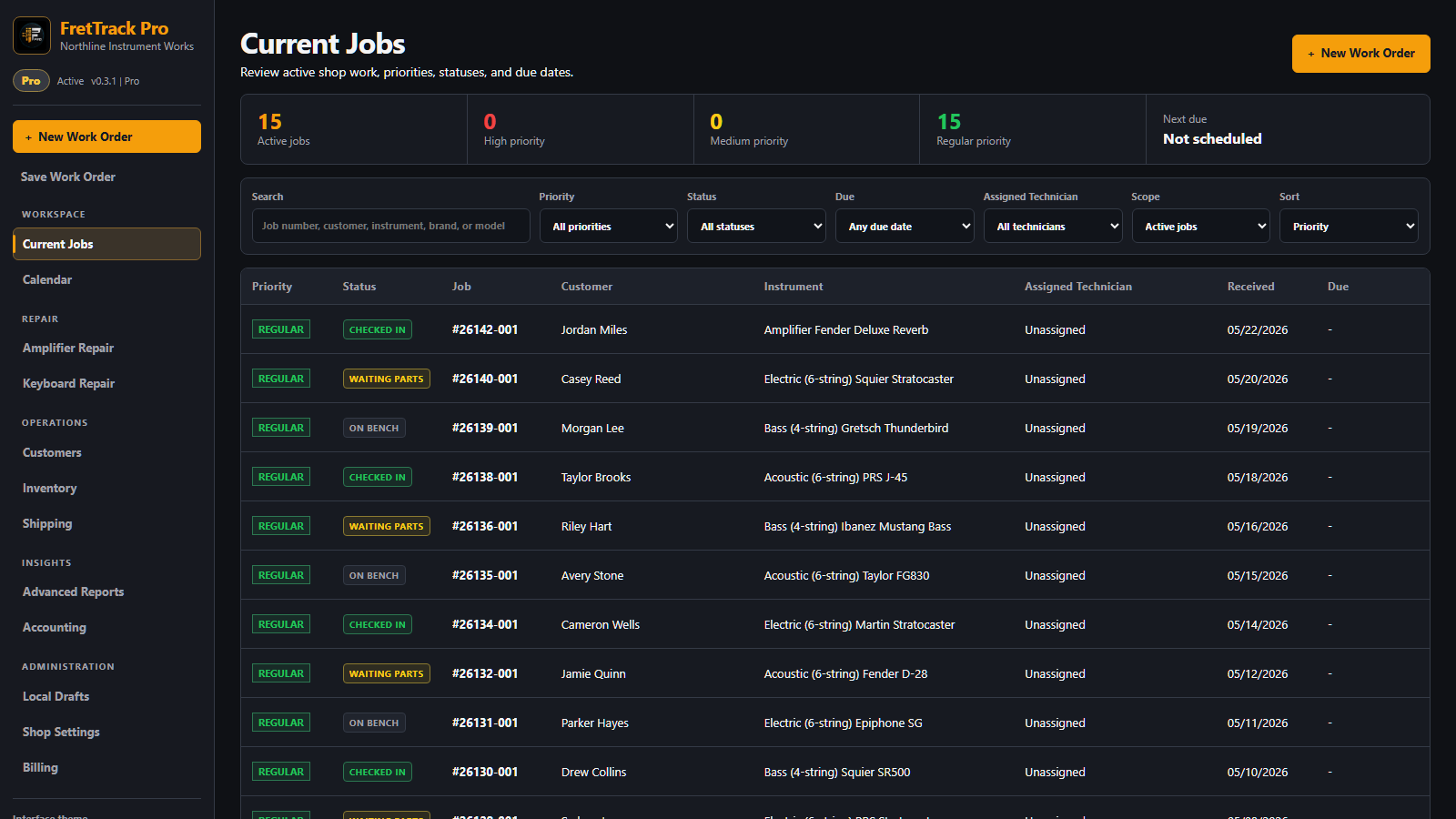
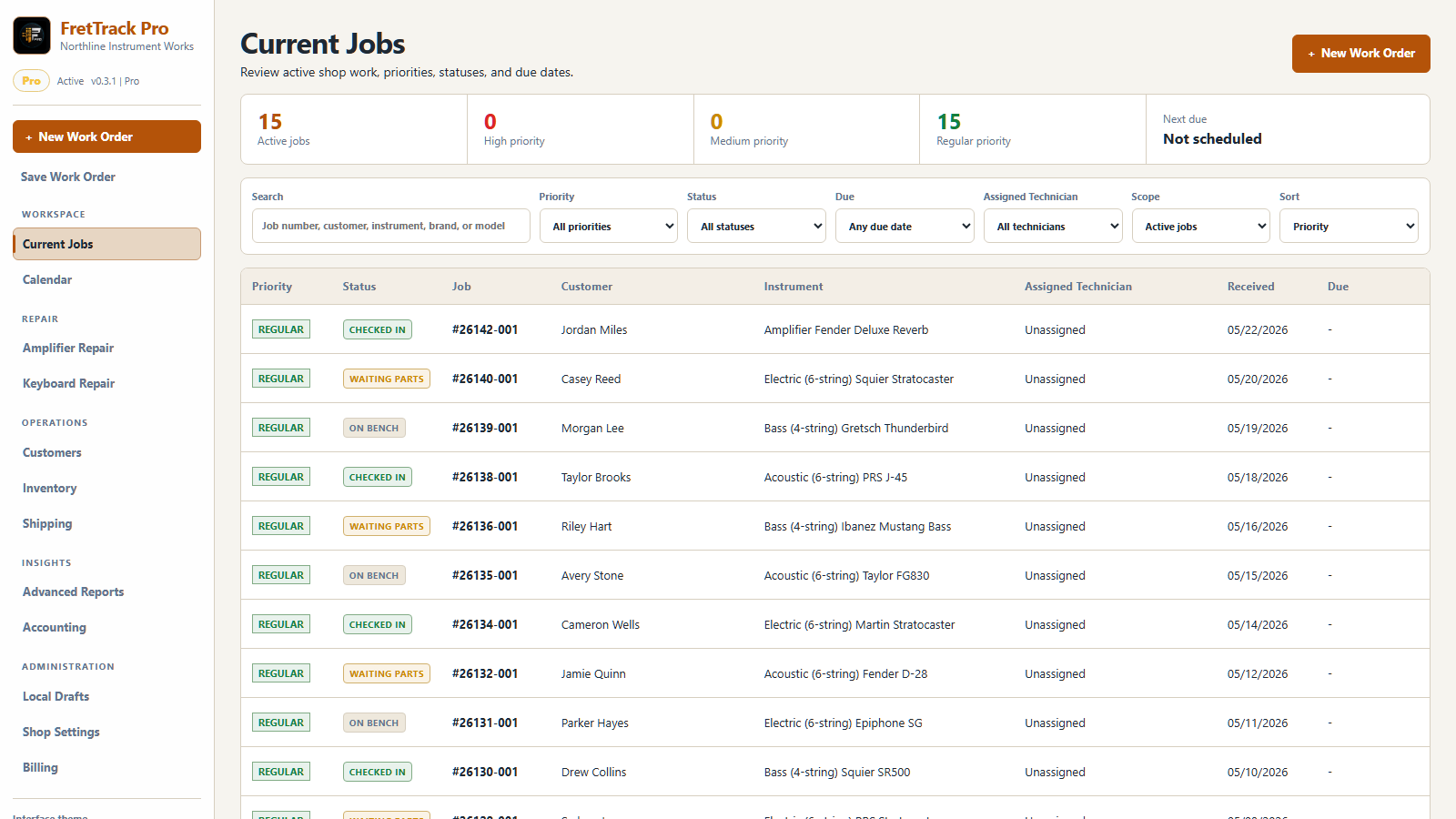
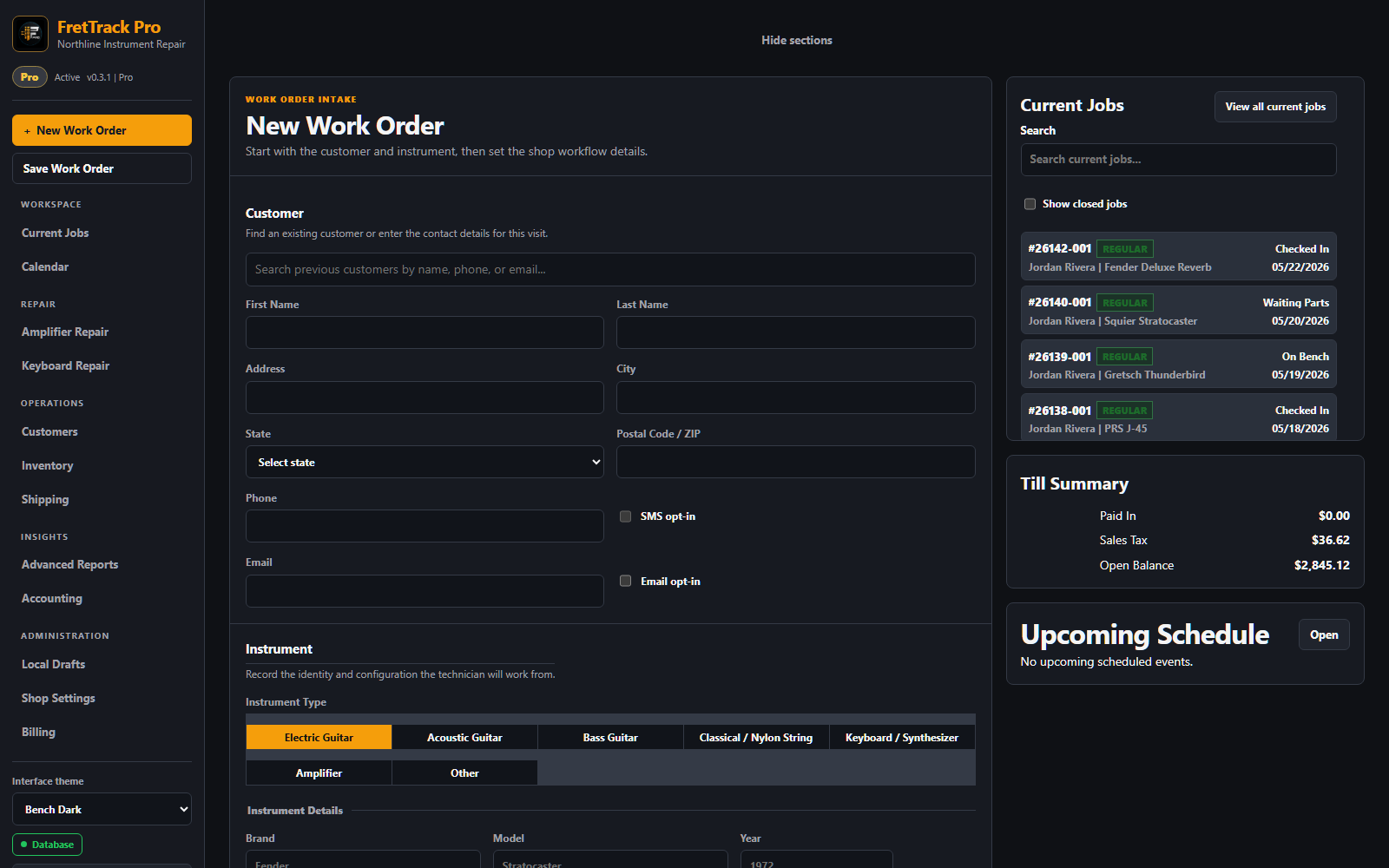
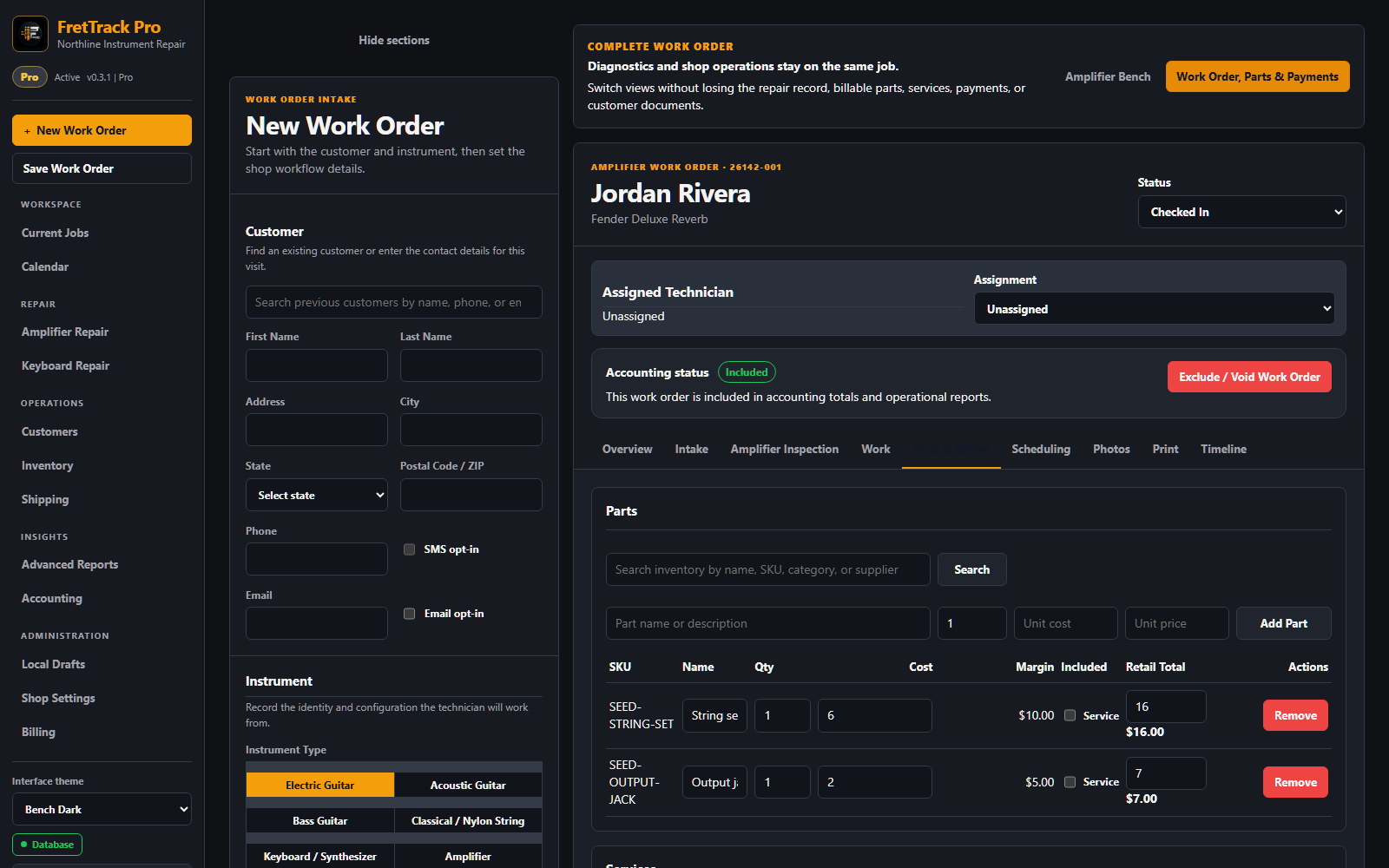
Screenshots show fictional shop and customer data.
Guitar, amplifier, and keyboard work orders open in focused repair benches while sharing one commercial workspace for parts, services, payments, messages, scheduling, photos, printing, and history.
The Customer Service and Condition Report and invoice-style Job Sheet now use isolated print renderers, wait for required images, preserve billing totals, and use terminology appropriate to the instrument.
Immediate email, Pro Scheduled Email, opted-in Automated Service Reminders, immutable message snapshots, cancellation recovery, and Message History keep customer communication attached to the work order. Signed Resend inbound email now places replies in a dedicated shop-wide Messages inbox, where staff can review the matched customer and deliberately route each reply to the correct work order. Customer profiles show only that customer's Conversation history.
Parts, expanded vendor records, safe vendor CSV preview/import and export, purchase orders, receiving, landed costs, vendor returns, barcode labels, specialist job purchasing, and explicit transfer into Parts & Payments support day-to-day shop work. The Shop-and-Pro Reorder Planner accounts for incoming ordered stock and prepares reviewable unsaved draft POs in whole vendor purchase units. Vendor imports skip possible matches instead of overwriting them. Draft vendor returns do not change stock; marking one shipped removes each whole-number quantity once, and the vendor's actual credit remains separate from customer billing.
Scheduling, customer history, accounting-safe work-order exclusion, advanced reports, team assignment, loyalty, localization, usage limits, and permission-aware workflows are part of the stable product.
Parts & Billing now links a disabled tax profile directly to the clearly grouped Shop Settings → Tax / VAT section. Discount controls explain that Percentage or Fixed amount must be selected before entering a value, removing the previous dead-control appearance.
New shops can register, confirm their email, and create a workspace without manual approval. The free-trial link opens account creation directly, and an interrupted post-creation profile load can safely retry the existing workspace. New shops receive a non-converting 14-day Pro trial. Shop is $29.99 monthly or $299.99 yearly; Pro is $39.99 monthly or $399.99 yearly. Stripe Checkout and the Billing Portal handle subscription enrollment and management.
SMS delivery, browser Realtime inbox updates, public invoice links, carrier label/rate purchasing, and live supplier integrations remain outside the current release. Dedicated AmpTrack and MidiTrack add-on modules are planned later for still deeper specialist workflows. FretTrack is repair-shop workflow software and does not replace professional accounting, tax, or legal advice.
Start with the complete how-to guide, review troubleshooting, or contact support@frettrack-app.com.